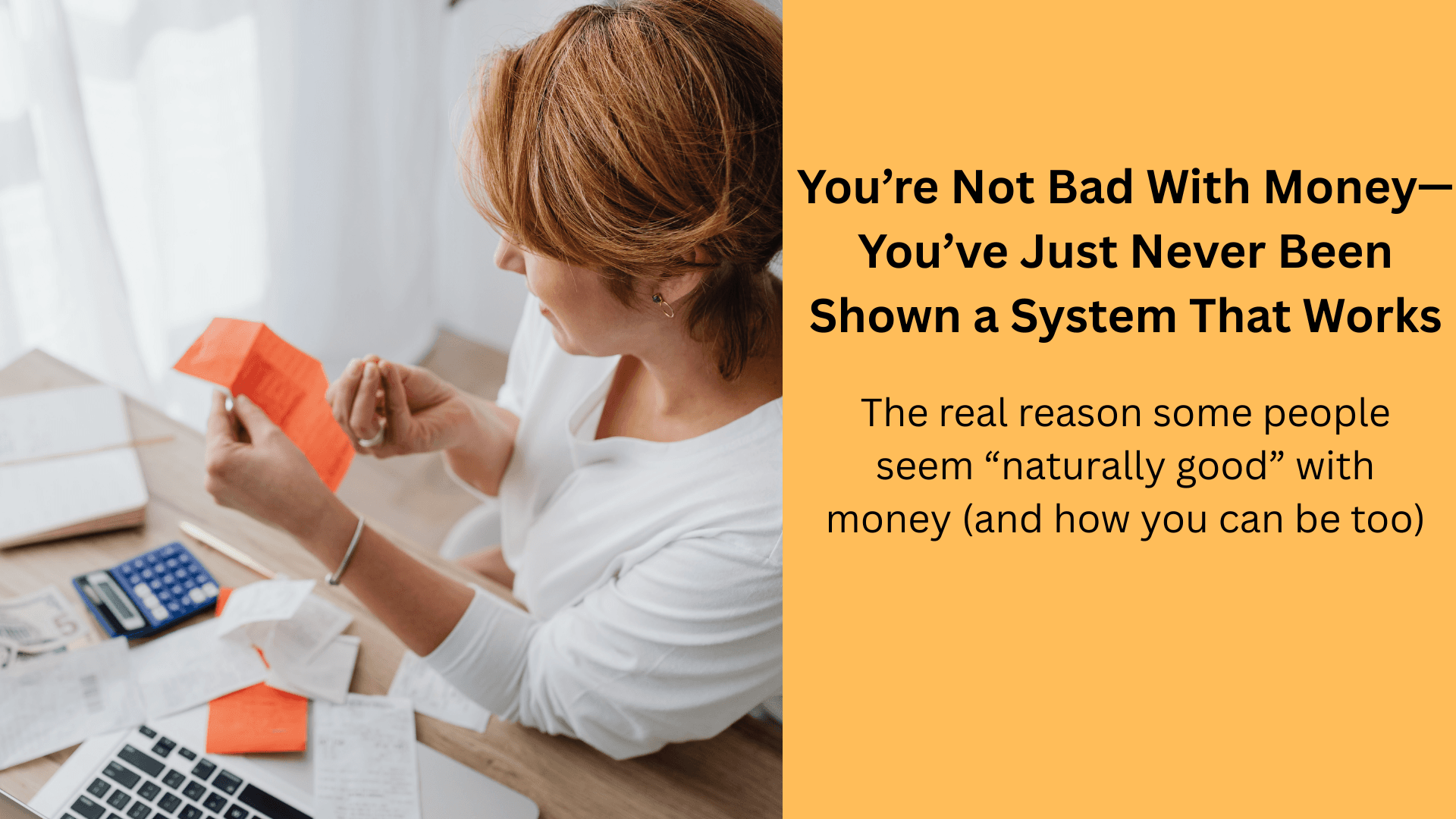
You're Not Bad With Money—You've Just Never Been Shown a System That Works
When you are the one struggling with money, it seems like everyone around you is just naturally good with money. Sure, you might have that one friend who is constantly mentioning their money struggles, so you think, "they are like me, not good with money."
But you assume everyone else is just good with money. You compare yourself to this false narrative, and it feels terrible. You feel behind when it comes to money. You have too much debt, not enough saved.
Then somewhere along the way, you decided that it's like a golden ticket that's handed out at birth to be good with money. So, your hope of ever being better with money dissipates. But you are here, so there must be a little bit left.
I am a money coach who has helped people get better with money for over ten years, and this is common. You are not alone in your way of thinking.
In this post, I am going to walk you through how this belief comes to be in so many people.
Then I am going to show how there is no golden ticket, but there is a money code that people who are good with money have cracked.
I will then give you the essentials you need for cracking the code, so you can start to crack it for yourself and be better with money. Maybe even start saving or paying off your debt.
Ready? Let's go…
Is it true? Some people get the golden ticket, and some people, like you, are doomed to struggle with money forever.
It's easy to believe.
People don't talk about money. So, when you look around, you don't know if people are really good with money or if they can't sleep at night because they have so much debt.
When you see them go on vacation you assume they had the money to pay for that instead of put it on a credit card. But do you really know?
As a society, we don't talk about money and how to handle it.
So, you have no idea where your counterparts are in their money journey, and since you feel like you suck at it, you assume you are alone.
After all, no one else is broadcasting that they suck at it.
It's not your fault. Many people believe what you do. And when you believe you didn't get the golden ticket to be good with money, it can feel really hard to believe that you can change and have a different money experience.
Believing you aren't one of the chosen ones is keeping you from moving forward financially.
It's keeping you from starting to save, pay off debt, and most importantly, feel good about your finances.
Depending on how long you have believed this golden ticket idea, you may have even started to give up dreaming about doing amazing things like going on an international vacation or helping your kids pay for college. Maybe you have even started to give up the idea of retirement because you don't feel like it will work out for you.
I have seen this with my clients over the years. When they started working with me, they didn't believe they could be better with money because they thought everyone else had something they didn't, that golden ticket.
But as we worked together they were able to see it was a lack of knowledge and guidance that was keeping them from being good with money.
I also know this from personal experience. If someone knows me now, they would think I got the golden ticket. The truth is, I wasn't always good with money.
When I got my first job and started making a decent salary, I ended up in debt. I had been good at handling the little money I was making as I worked my way through college, but when my salary jumped, I wasn't as good at managing it.
It seemed weird because everyone always assumes that more money is the answer if you weren't given that golden ticket.
I realized I didn't know what was happening with my money and set out to change it.
Now I have a system, and I track my money. I know where all our family money is, and we are good at it, but that wasn't always the case.
I had to learn the things I teach my clients and what is infused into the Buckets of Money Budget.
By now, you might have realized there is no golden ticket. It's actually more like a secret language that no one taught you how to decode.
You hear people say all the time, "We should have learned to balance a checkbook in school."
I could balance a checkbook. I was good at it when I left high school, but I still had to learn to be good with money.
That is because it's more than balancing a checkbook or debit account.
Being good with money isn't just about adding and subtracting. It is about planning. Most people can pay their monthly bills for an amount of time. Then, eventually, one of two things derails most people and keeps them from getting back on track:
- Not planning for the things that aren't monthly
- Not figuring out how a new monthly payment will affect their financial life (buying a house, bigger utilities)
When you have a house, a car, kids, a pet, etc., your bills extend past the monthly numbers.
The bills become unpredictable, which makes them harder to account for. That can lead to unexpected expenses, which often lead to debt, adding a bill to your monthly expenses.
For example, when you buy a house, you are super excited, and you make sure you can afford the monthly payment.
But most people do not start saving for house repairs, which come up. Whether a toilet starts leaking a few months in or the water heater goes out, eventually, there are maintenance bills for your home.
Since no one told you to start saving for these repairs, you don't have a pile of cash saved to pay for the repairs.
So, out comes credit or financing because the repair has to happen. Then there is another $200 a month added to your payments, and most people don't adjust their budget so that they can adjust the rest of their spending.
If this happens a couple of times, it gets harder and more complicated to pay your bills and have money left over for the fun stuff.
If you were good with money, always had money to pay your bills, and then one day you didn't, this is why. You knew what the boundaries were, and you could keep your spending within them, but when the money available started to shrink, your mind didn't shrink what it thought was available.
This happens a lot. People were good with money, and then they woke up one day and realized they were no longer good with money.
People who are good with money have learned how to plan for expenses that are going to come up and adjust their budget as needed.
They weren't giving a golden ticket; they learned the code, and you can learn it too.
My partner and I were both good with money, and then we bought our house. It was bigger than we had ever owned, which meant the utilities were higher. We have a pool, so we had expenses for that.
The bigger the house, the more possible repairs there are. And because it was bigger, we wanted to furnish it.
All of these things added up, and it took us a few years to adjust the code to back on track with how we want to be with our finances.
When we bought our house, I was no longer keeping a budget for two reasons.
The first was that I trained myself to stay on a budget without an official budget. I didn't spend a lot of money on stuff, and I could stay within my grocery budget without trying because I had years of practice.
The other reason was that I didn't have very many things I needed to save for. I saved a lot of money and when I needed to pay $1000 for a car repair I had the money.
But once our expenses were higher, we had to create a budget system.
People who are good with money have a system.
Whether they have trained themselves like I previously had, or they have a budget that helps guide the flow of money in their lives.
Setting up a budget that helps you account for and track what you need to pay this month, and the bills that will come up, is crucial to cracking the code of being good with money.
A budget also helps you if you want to have money set aside for the fun stuff, too, like a vacation.
A strategic budget also helps you adjust your money to match your life.
This means if you decide to buy something, like a new car, you can adjust your budget to see if you have to cut some other expenses.
Ideally, once you set up a strategic budget, you would put in any new payments before you commit to them so you can see how adding that payment will affect your financial life. Then you can make an informed decision about adding that payment.
The Code To Be Better With Money
The code to being better with money is something anyone can crack if they have the code essentials. I know because I have seen it work in my life and the lives of people I have helped with this over the years.
First code essential…
Identifying all the things you have to spend money on, so that you know how much money you have available to spend on things you want to spend on.
Second code essential…
Looking beyond the monthly payments to see what money needs to be set aside for future payments. This includes expenses that often pop up and payments that have to be made at intervals other than monthly.
Third code essential…
Review your budget before adding expenses.
Fourth code essential…
Using a tracking system instead of your bank account to decide if you can buy something.
Fifth code essential…
Don't fudge the numbers.
How To Crack The Code To Being Better With Money
The first and second code essentials are part of the Buckets of Money Budget.
The first code essential:
Identifying all the expenses you have to pay so you know how much you have available for things you "want to" is the first part of setting up your budget in Buckets of Money.
Buckets of Money Budget guides you to ensure you are capturing everything you have to pay for in a month, before moving on to the things you want to pay for.
When people set up a budget on their own in a spreadsheet, it's common to miss something. Or forget something that is not a monthly bill.
That is where the second code essential comes in.
The second code is looking beyond the monthly.
This includes payments you have to pay, but are not monthly.
For example, we have to pay a stormwater bill twice a year. When setting up your budget in Buckets of Money, if you have a similar payment, you would:
Enter the amount Enter how often you have to pay it (2x a year)
Then the system calculates the monthly amount to save for this bill and deducts it from the remaining money you have available.
Inside Buckets of Money, you also set up ongoing buckets to save money for the things that might have felt like they just "popped up" in the past.
For example, you would set up an ongoing bucket for car maintenance. I helped Tania crack this part of the code in a workshop, and after about a year, she told me how she felt no stress when it came time to do an expensive car repair because the money was there.
Ongoing buckets can also be set up for the fun stuff, like vacation. You can set aside money monthly, so you get to be one of those people who goes on amazing vacations.
The third code essential comes after you have set up a strategic budget.
Raise your hand if you have ever just said yes to a new payment, like for a couch or car, without analyzing how it fits into your budget or what you might have to cut back on to afford the additional payment.
Code essential three requires teamwork between you and your budget.
You have to commit to:
Look at your budget to see how the additional payment will affect your financial situation before committing to the payment.
In the Buckets of Money Budget, you can add a payment to your budget.
If you have a balanced budget, as I suggest, which means you have every cent allocated, then it will show you how much you are negative after adding the payment.
You can then adjust your buckets until the balance is $0.
For example, if you wanted to add $250 a month to buy new furniture:
- You would add that payment to your budget.
- Then the system will show you have a negative $250.
- Then you would adjust things like savings, or how much is in your monthly fun bucket, until you brought your budget back to even.
The fourth code essential is to use your budget tracking instead of your bank account to see how much is available to spend.
Often, people, maybe even you, will look at their account balance and say, "Yeah, I can go out to dinner. I have money."
However, they don't take into consideration that two days from now, a payment of $200 will be coming out of their account. So this creates a game of catch-up.
When you learn this code essential, look at your tracking rather than your bank account to determine spending, and you will end the catch-up game.
When you set up a budget with a bucket for something like "eating out," you look at the amount you have remaining in the bucket before you go out to see how much money is left for the month. Then you determine if you can go out.
When your budget is set up with the code essentials one and two of accounting for everything, you have to develop the habit of sticking to what you have given yourself to spend in each bucket.
People who are good with money know what they have available and if they can say yes to something without putting themselves into a financially difficult place.
The fifth code essential is something you have to take on and honor for yourself.
People who don't see themselves as "good with money" typically fudge the numbers.
This means saying we only spend $400 on groceries when they spend $800. Or not setting up their budget with real numbers for things like house maintenance and car maintenance.
Being truthful with yourself about what the numbers are is the only way to create a plan to move financially forward.
Sometimes the numbers suck when you start this journey, but if you commit to cracking the code for yourself, the numbers get better, and you get better with money.
I know because I have done it and I have helped other people do it, like Vicki.
Vicki thought she was bad with money and wasn't capable of being better. If overdrafting your account were an Olympic sport, she would have a gold medal or two.
That is who she was.
But she wanted to be better with money, so she committed to cracking the code.
Now, she pays her bills with ease and has multiple savings accounts. She even started investing in a retirement account.
Are you ready to crack the code to being better with money?
If you said yes, you know you need to set up your budget to start cracking the first two code essentials.
Let's do it!
Your Next Step-
Sign up for the Buckets of Money Budget.
It walks you step-by-step through setting up a budget designed for real life — with more success and far less failure built right in.
You can start learning the code today!
This Was Built To Help You Become Someone Who Is Good With Money!
Inside the Buckets of Money Budget, the system will walk you through setting up a budget based on your life.
It will guide you through a proven, step-by-step system for creating a budget you can set up and maintain.
You'll get the tools, structure, and support you need to:
- Set up a budget on your terms
- Make tracking simple, so you actually do it.
- See what money you have available to use
- Enter planned transactions to make sure you have money left for the good stuff
- Make it easier to stick to your budget with the weekly view option
And you don't have to figure it all out alone.
Every part of the Buckets of Money Budgeting tool is designed to help you get better with money — and feel confident doing it.
Get started now and start changing who you are with money.
→ Click here to sign up. Use the coupon code BLOG for a discount!